


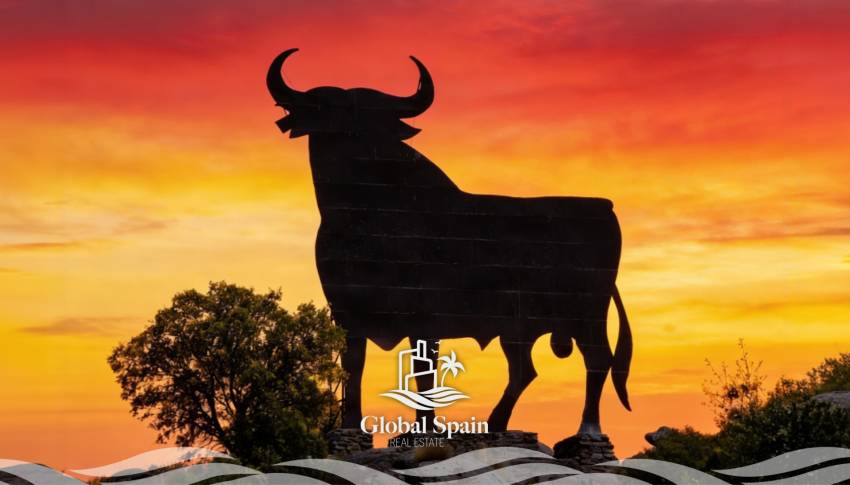
The Black Bull of Spain: From Advertising to National Symbol
Travelers in Spain can hardly miss it: a massive black bull towers high above the landscape. Silent, powerful, and mysterious, it watches over highways, hills, and plains. For many visitors, it's a striking landmark, but for Spaniards, this bull is much more than just a decorative object. What once began as a sherry billboard has become one of the country's most iconic symbols.
From sherry advertising to landscape icon
The famous black bull was designed in 1956 by the Spanish advertising agency Azor. The commissioner was the Osborne winery, which wanted to promote its sherry along Spanish roads. The first bulls were made of wood and bore the name "Osborne" prominently on their flanks. They were strategically placed along major roads to draw motorists' attention to the brand.
In the 1960s, the wooden versions were replaced by metal structures. They became larger, sturdier, and increasingly dominant in the landscape. The bull became a recognizable image for anyone traveling in Spain.
The ban on advertising along the roads
In 1988, everything changed. The Spanish government introduced a law banning advertising along highways to promote road safety and landscape protection. The Osborne bulls had to disappear.
Osborne adapted: the brand name was removed, but the bull itself remained. However, this too was later questioned. In 1994, the government decided that the unbranded bulls also had to be removed.
That decision led to a wave of protests.
A national symbol is born
Spaniards no longer saw the bull as advertising, but as cultural heritage. Artists, politicians, and citizens took action. For many, the bull had become a symbol of strength, tradition, identity, and pride.
The Spanish Supreme Court ultimately ruled that the bull could remain, as it had acquired cultural and artistic value. Since then, the bulls have been protected as part of the Spanish landscape.
What does the black bull symbolize?
The bull is deeply rooted in Spanish culture. It symbolizes:
- Strength and pride
- Tradition and heritage
- Freedom and independence
- Spanish identity
- The connection with the countryside and nature
Although bulls are often associated with bullfighting, the Osborne bull transcends that meaning. It has become a universal symbol for "Spain."
How many bulls are left?
Once upon a time, there were more than 500 of them scattered across Spain. Today, only about 90 remain. They are primarily located in strategic locations where they are visible from highways and in open landscapes, often on hills or along vast plains.
Each bull is approximately 14 meters tall and weighs several tons. They are maintained as cultural heritage.
More than a silhouette
The black bull has become a beloved icon in art, fashion, and tourism. You see it on T-shirts, keychains, flags, and souvenirs. For many expats and visitors, it symbolizes the feeling of freedom, sunshine, space, and authentic Spain.
For Spaniards, it's a piece of history. A silent witness to how a simple billboard could become a national symbol.
The bull in modern Spain
In a country constantly balancing between tradition and modernity, the Osborne Bull symbolizes continuity. While Spain continues to develop, the bull remains unchanged as it watches over the landscape.
It evokes simplicity, strength, and identity. And perhaps also the desire for a life with more space, sun, and character – precisely what draws so many people to live or invest in Spain.